
A loyalty programme rewards behaviour that repeats. You decide what earns points, we keep it running — and your participant picks a gift from 3,000 rewards across 350+ brands. No set-up costs, and your invoice follows redemption.
A loyalty programme rewards behaviour that repeats. You agree in advance which behaviour earns points — a target met, a colleague referred, a month without an accident, an order placed with your wholesaler — and whoever collects points exchanges them for a gift of their choosing.
A gift is one moment. A loyalty programme keeps running and keeps steering for as long as it runs. Which is why we do not simply call it rewarding: what gets rewarded gets done.
Each of these is one rule in your programme. You pick which ones, and what they are worth in points.
A loyalty programme stays abstract until you see how it runs somewhere else.
Four examples running today, in four very different sectors.
Every team that closes a full quarter accident-free earns points. Visible on a board in the hall. This runs today as a safety programme at a manufacturer.
Points per order or on reaching a threshold, added up over the year. The dealer watches the balance grow and knows what the next order is worth to them.
Points at application, points on hire, points after six months. That way you reward not only the passing on of a name, but the quality of the match.
The unglamorous things that never happen: reports filed, CRM updated, hours entered. A small number of points, every month. This is where a loyalty programme pays off most and is used least.
The same platform serves three very different groups. Same machine, different rules.
Same machine, different rules.
Three steps, and only one of them is in your hands. The other two we and your participant handle between us.
You decide which behaviour earns points, and for whom. Awarding happens by hand where it has to and automatically where it can.
The balance sits in their name and grows. Not a code that expires, but a credit that is a reason to do the right thing again next month.
Redeeming whenever they are ready, from a range we keep current. Delivery, returns and warranty land with our helpdesk, not with you.

Earn · Save · Enjoy
Thanks is the platform your loyalty programme runs on. Your participants earn points through behaviour you define, they save until they are ready, and they choose where their points go. To them the programme is called whatever you call it — Thanks sits discreetly at the bottom.
thanks — powered by Attent Loyalty
A gift says thank you. A loyalty programme steers. That is a different instrument, with six advantages a one-off gift cannot deliver.
If what you want is not a programme but a single moment, Smiles is what you need.
A gift is one moment. A balance that grows is a reason, every month, to do the right thing.
Not just revenue. Safety, punctuality, paperwork, referrals and training too — everything that carries no bonus but keeps your organisation running.
Points become a gift they pick themselves from a range we keep current. Nobody gets something they have no use for.
You see who takes part, who drops off, what gets chosen and what it costs. A one-off gift gives you nothing back; a programme produces steering information.
The same platform serves employees, dealers, installers and customers. In a distribution channel it is often also the way to gather data on end customers.
Our largest programmes run to tens of thousands of members; the smallest has eighteen. Same machine, different size — so you can start small without having to move house later.
You are rarely shown an admin screen in this market. Below are eight screens from a programme running today — the environment you work in, and the site your participants see. You get your own admin environment, alongside ours.

Your own logo, programme name, baseline and imagery, with a language selector at the top right.
At the bottom sits the Thanks wordmark with powered by Attent Loyalty — exactly the right degree of presence.

This image explains the mechanism without a word of text: everything has a price in points, and the filter runs from 4 to 2,800.
Champagne next to a day at a theme park next to a set of pans — that spread shows there is something at every savings level. Those 1,660 are the catalogue of this programme: a selection from our 3,000 rewards, matched to the audience.

The balance with the history beneath it: which award, which month, how many points.
That last part matters more than the balance itself — someone who can see where their points came from knows what to do to get more.
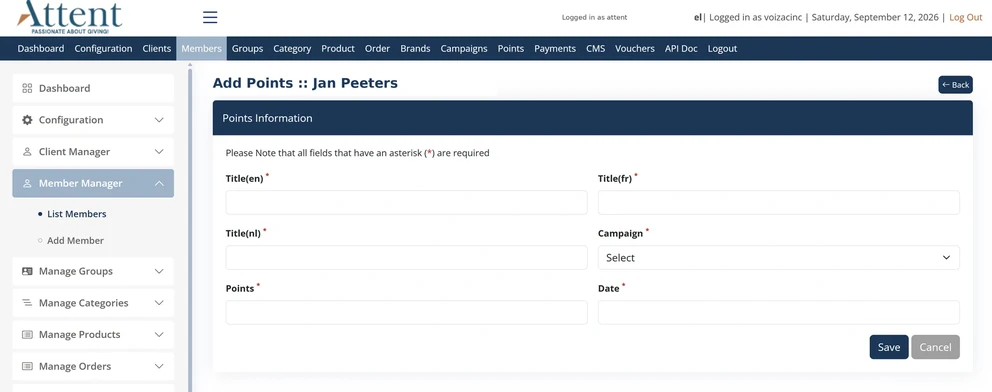
You pick the member and the campaign it falls under, give the award a title and add the number of points. That is all.
That the title can be in three languages is not a detail: your participant reads their history in their own language.

Note the fields Client and Group: that is how the same platform carries several programmes and segments side by side.
Installers separate from dealers, Flanders separate from Wallonia — each with their own rules and their own range.

Orders with their status and date, filterable by status and period, and one button to export the lot.
That last part is the question every finance team asks: what has been redeemed this period, and what is still outstanding?
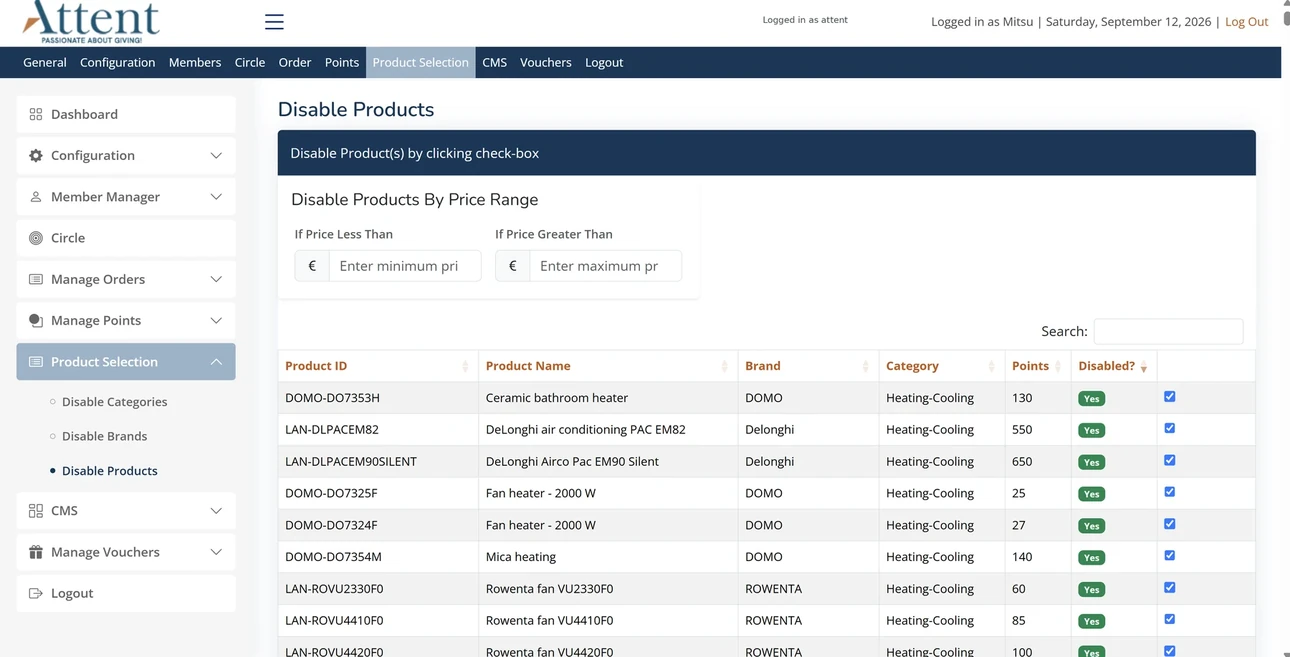
Switch products off per item, per brand, per category, or in one go by price band.
In practice: no alcohol in your programme, no competing brands, or nothing above a given value. You arrange that yourself, without picking up the phone.
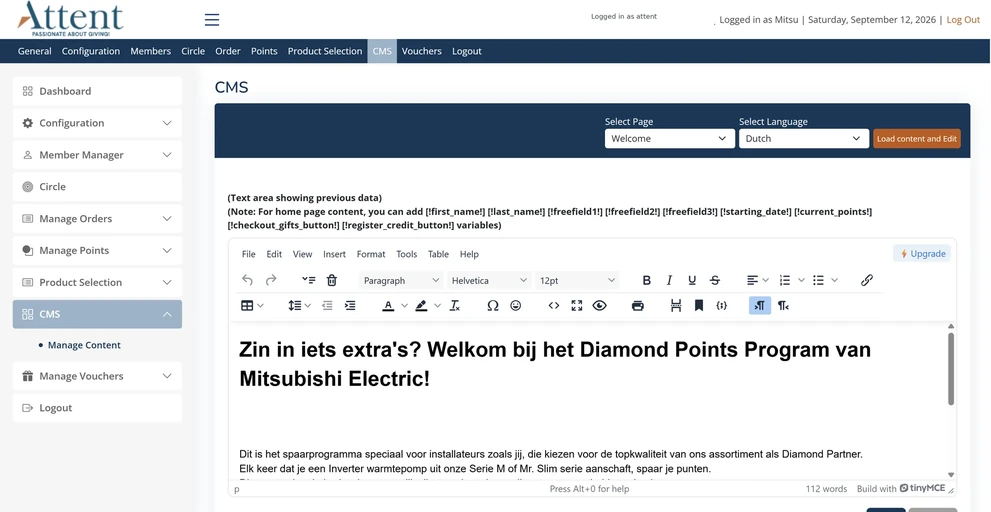
An ordinary text editor, per page and per language, with merge fields: first name, surname, start date and the current points balance in the middle of your own text.
Together with the previous screen, this answers the question nobody in this market answers: what can I do myself, and what do I have to call about?
Eight things you can do without us. What you would rather not do yourself, we do — but then because you prefer it that way, not because it is impossible.
Individually, in bulk, or automatically on a rule. And reverse an entry when something went wrong, without calling.
Add, import, group into segments, deactivate on departure. By hand or automatically from your employee records.
How many points something earns you decide in the moment, per campaign. What has to be ready in advance are your members and your campaigns — the rest is yours.
A ceiling per period or per group, and a view of how much is left before the year is out.
Participation, points awarded and redeemed, what gets chosen. In an export your finance team will accept.
How many points are still outstanding today, per programme and per group. And you can act on it: expire points or write them off.
Who may award, who may only look, who sees the figures.
A reminder to anyone holding points, a message when a new campaign starts. Unused points are a missed opportunity, not a saving.
You do not have to build anything. But if your system can talk, ours talks back.

This is a real call to our API. One message with an employee’s details and their opening balance, and the response contains their member number and a personal login link.
That link does the work: your employee has no account to create and no password to remember. They click from your intranet or your email and land straight on their own balance.
And to be clear about it: you do not have to do this. An import works just as well. But anyone who wants to integrate can — and then we build towards your system, not the other way round.
That is the first question a finance director asks, because it is an obligation still coming your way. In the admin environment it is a figure you look up, not a question you have to ask.
Want to know what that means in euros? We work that out for you, based on the point value agreed in your programme.
One step takes thought on your side. The rest we do.
Which behaviour you want to see, who takes part, what it earns. This is the only part you have to think about yourself — and usually the most enjoyable conversation of the whole process.
In your house style, with your logo and tone, with a range that suits the audience and the points level. We configure where others program.
Through an import or a link to your existing systems. From then on new and departing members follow automatically, and you stop circulating lists.
With an announcement we help you write. A loyalty programme nobody knows about does not collect anything — the launch is not a formality.
By hand where they have to, automatically where they can. You watch and adjust; we keep the range current.
At the office or at home. Returns, warranty and members’ questions go to our helpdesk, not to you. And your invoice follows redemption.
No upfront investment in software, set-up or design. No subscription, no licence per user. You are not paying for the system, you are paying for the rewards.
Points only become an invoice at the moment somebody redeems them. What stays outstanding is not yet on your books.
No system cost coming off your budget. What you set aside reaches your members — not a licence.
You buy nothing in advance. No leftover batch, no boxes in a corridor, no written-off stock from a programme that ran differently than planned.
The first question from finance, and from every HR manager. The answer depends on who is saving and what for.
For the occasion-based moments with their own exemptions, see long-service awards(in Dutch).
Then this is pay. Points earned through a target, a KPI or punctuality are treated for tax purposes like a bonus: RSZ (Belgian social security) and withholding tax apply. That is not a detail you can make disappear by calling it a gift.
A work anniversary, a retirement, an end-of-year moment: there, exemptions do exist, with their own amounts and conditions. Which is why many organisations run their loyalty programme alongside their occasion-based moments rather than dressing one up as the other.
Here the pay question does not arise: there is no employment relationship. For you it is a commercial cost, and for them a business benefit. That makes a B2B loyalty programme considerably simpler administratively than an employee programme.
You are in the driver’s seat and hold the reins.
Happy members in our loyalty and gifting programmes.
From which your programme’s catalogue is assembled.
Brands your participants recognise, from household names to experiences.
From agreeing the rules to a running programme.
Six different programme types at six different clients — same machine, different rules.

Motivating a multi-channel distribution network: the classic B2B set-up, and the heaviest of them. This is how a referral programme for customers works.

Proof that a loyalty programme is about more than revenue.
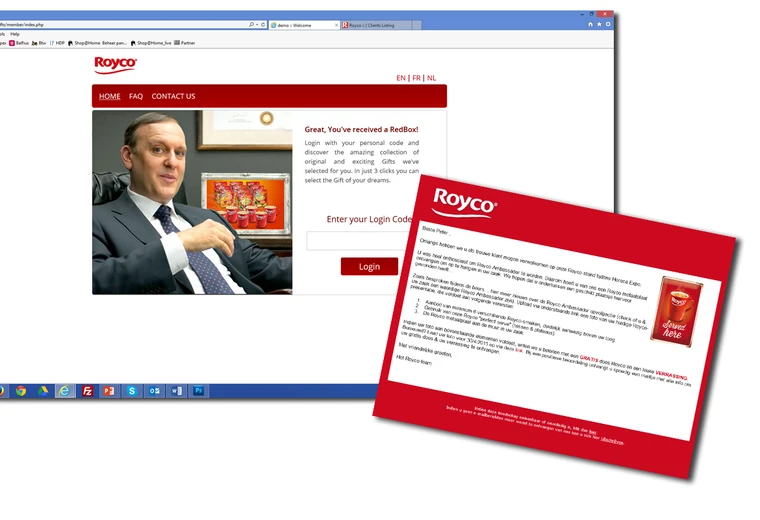
The consumer side, with return on investment as the angle.

Literally the product of this page: collecting points and redeeming them.

Customer retention in FMCG, with a points currency of its own.
Thousands of employees and agents in one platform.
“We have worked with Attent for several years now on the loyalty programme in our app. They keep the range up to date so that we are always on top of the latest trends — and so our customers stay happy.”
Hannah Vereecken
Bakery marketeer, Algist Bruggeman
“We work with Attent on CopaCoins and on plenty of other things. The easy communication and the excellent quality make them the partner of choice — their service reaches further than gifts alone.”
Robin Peeters
Marketing Administrator, Copaco
The first four are the questions a reader really asks. The last four take on the objections.
Time. A gift is one moment and says thank you for something that already happened. A loyalty programme keeps running and keeps steering behaviour for as long as it runs.
Most organisations do both, incidentally: occasion-based moments separately, and alongside them a programme that rewards all year round.
Awarding points where it has to be done by hand, and the occasional look. That is it.
What can be automated — new and departing members, points on a rule — runs without you. Range, delivery, returns, warranty and participants’ questions land with us.
No. We build the integration towards your systems, not the other way round.
If you cannot or would rather not integrate, an import works just as well and a file is enough.
There are no set-up costs and no licences. You pay for the rewards, and only at the moment somebody redeems their points. What stays outstanding is not yet on your books.
Then nothing has been invoiced either. But that is not the aim: unused points are a missed opportunity, not a saving.
Which is why there is a reminder function in the admin environment, and why we help with the communication.
Yes. You switch products off per item, per brand, per category, or in one go by price band. No alcohol, no competing brands, nothing above a given value: you set that yourself.
Yes, and that is one of the strongest applications. The same platform carries employees, dealers, installers and customers side by side, each with their own rules and segment.
Our smallest programme has eighteen members, the largest tens of thousands. There is no lower limit, because there is no set-up cost to earn back first.
Tell us which behaviour you would like to see, and we will think through the rules with you. No presentation, no obligation — and if a loyalty programme is not the right instrument, we will say so.
Thanks is the loyalty platform we set up and run for you. It is not a webshop and not a place where anyone can buy: only participants in your programme get in, and they settle with points you have awarded.
Points have no cash redemption value and are not transferable; the rules of your programme are set out in the terms we draw up together.
What you read above about pay, RSZ and exemptions is information and not advice. Amounts and conditions change, and the correct treatment depends on your situation.
Put your set-up to your payroll agency or your accountant once before you start — we are glad to help sharpen the question, but we give no tax certainty.
The screenshots come from programmes running today; participants’ names and data have been replaced with examples.
Product counts, point values and the make-up of the range change through the year. Client names and logos are shown only with their permission.
Necessary cookies are always on: without them the site does not work. Beyond that we would like to measure how the site is used and recognise which companies find us. We only do so if you agree. There is more detail in our cookie policy.


 NL
NL